The Ihsan Agile Guide
A modular, practical framework for Muslim-led teams to embed iḥsān in Agile delivery, aligning daily decisions, technical practices, and product stewardship with God-consciousness, transparency, justice, and public benefit."
Download the Guide (PDF) • Version 1.1 • 1447 AH/ 2026 CE Edition • Updated framework • 66 pages
Licensed under Creative Commons Attribution-ShareAlike 4.0 International
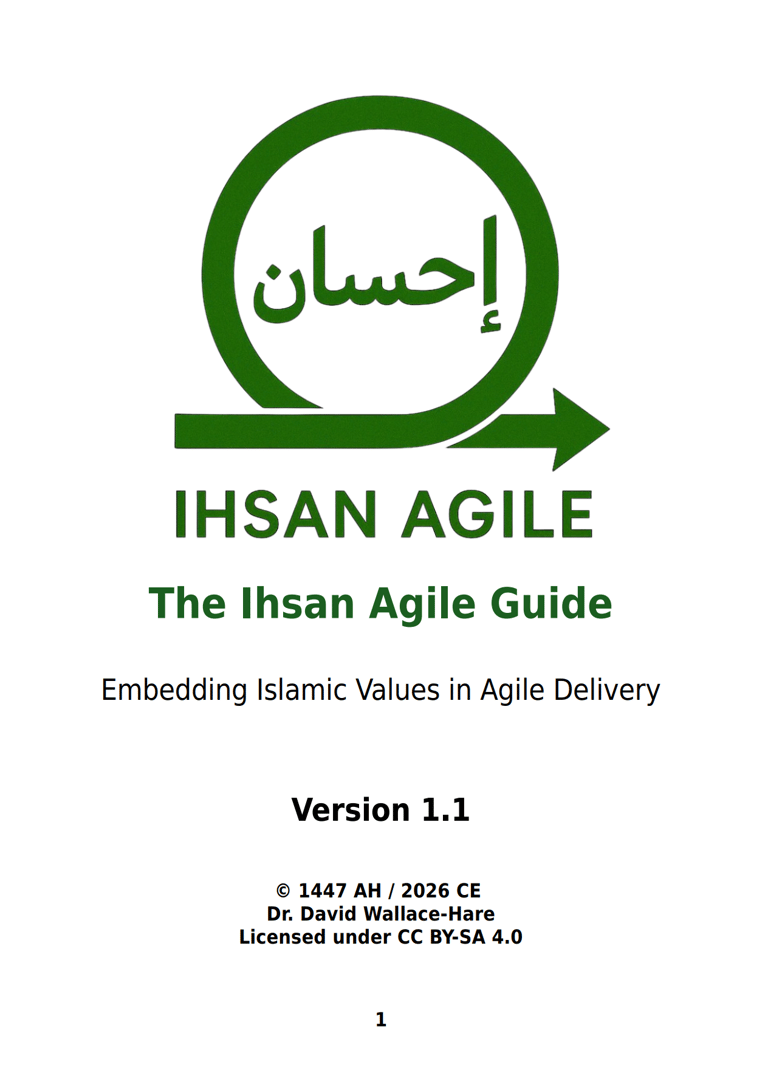
Download the Official Ihsan Agile Guide (Version 1.1)
Open-source • Practice-focused • Updated for responsible delivery under pressure
The Ihsan Agile Guide provides a framework for embedding Islamic principles into Agile delivery practices. It includes:
The Essence of Ihsan Agile - Foundation, definition, and Three Pillars (Niyyah, Iḥsān, Maṣlaḥah)
Five Core Principles - Taqwā, Stewardship (Amānah & Khilāfah), Shūrā, Service & Justice (ʿIbādah & ʿAdl), and Tazkiyah, each with Agile applications rooted in the Qur'an and Sunnah
Roles in Ihsan Agile - Detailed descriptions of the Ihsan Agile Facilitator (IAF) and the Ihsan Agile Product Steward (IAPS), and how they integrate with existing Agile and Product roles
Core Practices - Ihsan Check-ins, Reflective Retrospectives (Muhāsabah), Stakeholder Barakah Reviews, and Continuous Niyyah Alignment
Technical Disclosure & Uncertainty Stewardship – Practical guidance on identifying, documenting, and responsibly disclosing technical and product uncertainty, including the Technical Uncertainty Register and ethical decision checkpoints
Scaling Ihsan Agile - Guidance for extending the framework across team, program, and portfolio levels
Getting Started - Practical steps for beginning your Ihsan Agile journey
Method-Specific Appendices - Framework maps for Scrum, Kanban, SAFe, and Scrumban showing exactly where Ihsan Agile overlays integrate
Starter Checklists - Print-friendly checklists for Planning with Niyyah, Ethical Completeness, Muhāsabah Retrospectives, and Stakeholder Barakah Reviews
What's Inside the Guide
Why Version 1.1 was added (1 Shaban 1447 AH / 20 January 2026)
As Muslim-led teams scale and deliver under pressure, ethical risk often arises not from intent, but from undisclosed uncertainty: shortcuts, assumptions, and trade-offs that are known internally but inherited by others without consent.
Version 1.1 strengthens Ihsan Agile’s focus on stewardship and responsibility by making uncertainty visible, owned, and ethically managed within everyday Agile and Product decisions.
This guide is for:
Muslim-led tech organisations and Islamic fintech startups seeking to operationalise Islamic values in software delivery
Islamic charities and NGOs using Agile for campaigns, programs, or service delivery
Agile practitioners in Muslim organisations who want to align their work with Islamic principles
Shariah boards and governance leaders looking to extend ethical oversight into operational delivery
Muslim software development teams wanting to embed ihsan into their daily practices
Who Should Read This Guide
Current Edition: 2026 (Version 1.1)
Ihsan Agile incrementally updates based on a variety of metrics which can include:
Refinements based on academic research
Insights from pilot organisations
Community feedback and contributions
Refinements based on practical implementation
Framework Development & Versioning
License: Creative Commons Attribution-ShareAlike 4.0 International (CC BY-SA 4.0)
You are free to:
Share - Copy and redistribute the material in any medium or format
Adapt - Remix, transform, and build upon the material for any purpose
Under these terms:
Attribution - You must give appropriate credit to "Ihsan Agile by Dr. David Wallace-Hare" with a link to ihsanagile.org
ShareAlike - If you adapt or build upon this work, you must distribute your contributions under the same CC BY-SA 4.0 license
No additional restrictions - You may not apply legal terms or technological measures that legally restrict others from doing anything the license permits
Proper attribution example:
"This work adapts content from the Ihsan Agile Guide by Dr. David Wallace-Hare (https://ihsanagile.org), licensed under CC BY-SA 4.0. Changes were made."
Important note: While the Ihsan Agile framework is open and free, this Guide references other frameworks (Scrum, Kanban, SAFe) that have their own trademarks and licenses. Please see Appendix A in the Guide for full attribution details.
License & Attribution
Ihsan Agile builds on widely adopted Agile practices, reinterpreted through Islamic values. The Guide references:
The Scrum Guide™ (2020) by Ken Schwaber & Jeff Sutherland (CC BY-SA 4.0) - No endorsement implied
The Kanban Guide™ by Orderly Disruption Limited & Daniel S. Vacanti, Inc. (CC BY-SA 4.0) - No endorsement implied
SAFe® and Scaled Agile Framework® - Registered trademarks of Scaled Agile, Inc. - Not affiliated or endorsed
Collaboration with the Ihsan Agile framework is welcomed as a form of shirkah fī al-khayr (partnership in good). Teams and organisations are invited to adapt, translate, and share this guide for the benefit of the ummah.
Framework References & Acknowledgments & Attribution
Ihsan Agile is being developed with the community, not just for the community. Your feedback helps refine the framework and build a body of practice for Muslim tech.
Ways to contribute:
Pilot the framework - Join our pilot program to test the IAF and/or IAPS roles in your organisation (learn more)
Provide feedback - Share your thoughts on the Guide, suggest improvements, or report implementation challenges (getinvolved@ihsanagile.org)
Adapt and share - Under the CC BY-SA 4.0 license, you can adapt this framework for your context and share your adaptations with proper attribution
Translate - Help make Ihsan Agile accessible to non-English speaking Muslim communities
Contribute & Provide Feedback
Download the Official Ihsan Agile Guide (Version 1.1)
Open-source • Practice-focused • Updated for responsible delivery under pressure
© 1447 AH / 2026 CE. All rights reserved.
"What is Ihsan (perfection)?" Allah's Messenger (ﷺ) replied, "To worship Allah as if you see Him, and if you cannot achieve this state of devotion then you must consider that He is looking at you."
Sahih al-Bukhari 50